
The New Silk Road: How Central Asia Became Global Trade's Backbone
Central Asia is no longer simply a region between major markets. Its geography is becoming a strategic advantage as new railways, ports, roads, and trade corridors connect China with Europe and the Middle East.
The map of global trade is being redrawn
For centuries, Central Asia was known as the bridge between civilizations.
Caravans crossed its deserts and mountains carrying:
- Silk
- Spices
- Metals
- Textiles
- Ideas
The modern version of that history looks very different.
There are no caravans crossing the desert.
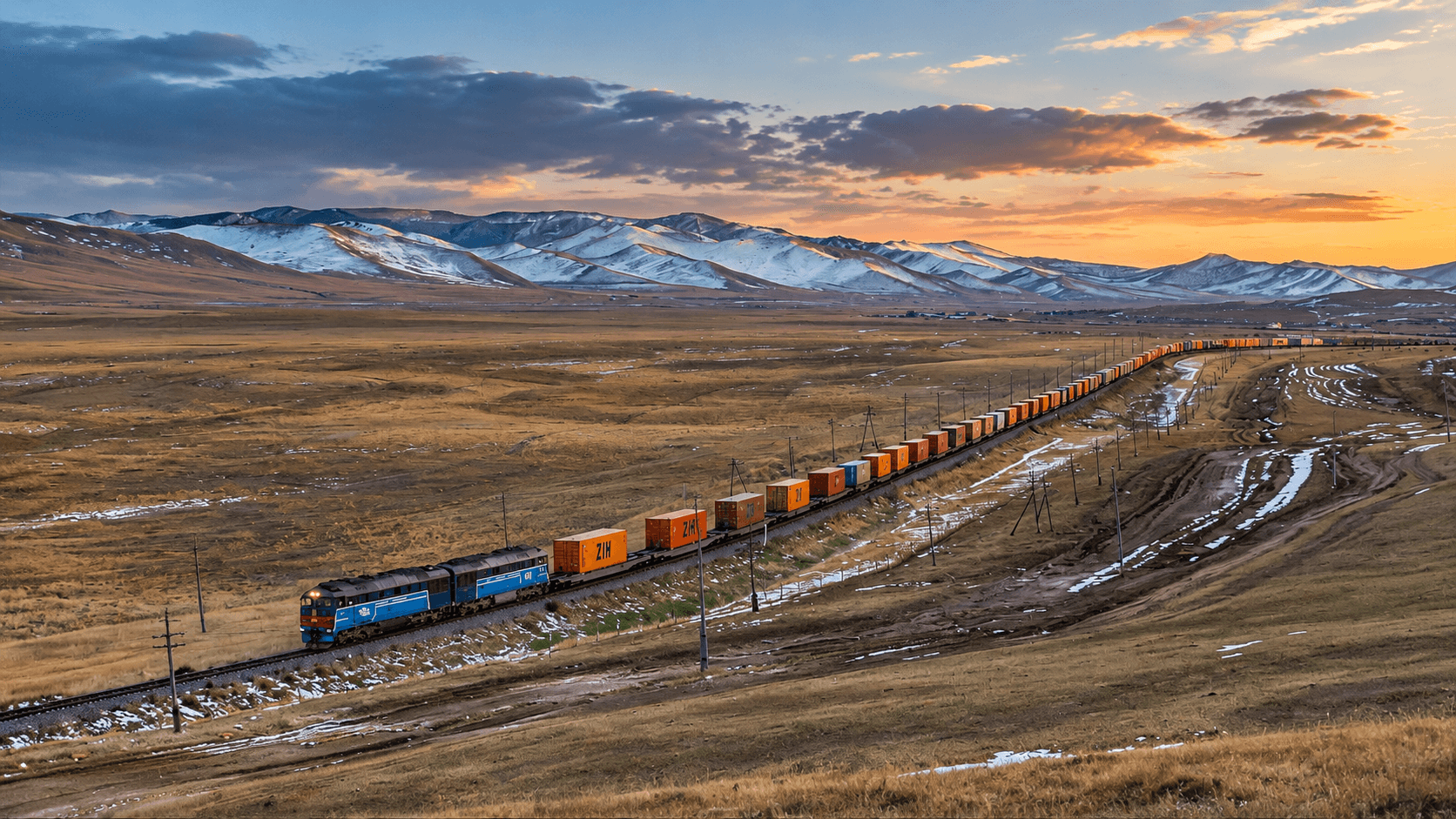
There are container trains, dry ports, digital customs systems, highways, and multimodal logistics hubs.
But the basic idea remains the same:
Central Asia connects markets that would otherwise be separated by enormous distances.
Geography is becoming an advantage again
For much of the modern era, being landlocked was viewed primarily as a disadvantage.
Today, that picture is becoming more complicated.
Countries in Central Asia sit between:
- China
- Russia
- The Caucasus
- Turkey
- Europe
- South Asia
That position creates enormous strategic importance.
The growth of routes such as the Trans-Caspian or Middle Corridor has increased interest in connections running through Central Asia and the Caucasus toward Europe. Academic research and infrastructure development increasingly emphasize the role of rail corridors in supporting regional economic integration.
This is not one road
One of the biggest misunderstandings about the New Silk Road is imagining it as a single route.
In reality, it is a network.
A shipment may travel through:
- China
- Kazakhstan
- The Caspian Sea
- Azerbaijan
- Georgia
- Turkey
- Europe
Another may move through:
- China
- Central Asia
- Iran
- The Gulf region
The future of the region will depend on how effectively these routes connect.
Infrastructure alone is not enough
A railway can be modern. A port can be efficient. A highway can be newly constructed.
But if customs systems are slow, the entire supply chain slows down.
That is why the next stage of development will depend heavily on:
- Digital documentation
- Electronic customs systems
- Better border coordination
- Cargo tracking
- Data sharing
The New Silk Road is becoming as much a digital project as a physical one.
A new logistics mindset
The most important shift may be psychological. Companies no longer need to think of Central Asia as a distant region that goods simply pass through.
It can become:
- A distribution hub
- A manufacturing base
- A transshipment point
- A connection to new markets
This creates opportunities for businesses that understand regional logistics deeply.
Final thought
The Silk Road never disappeared. It changed.
The camel was replaced by the container.
The caravan route became a railway.
The marketplace became a logistics hub.
And the future of global trade may increasingly depend on the regions that connect the world's major economic powers.