
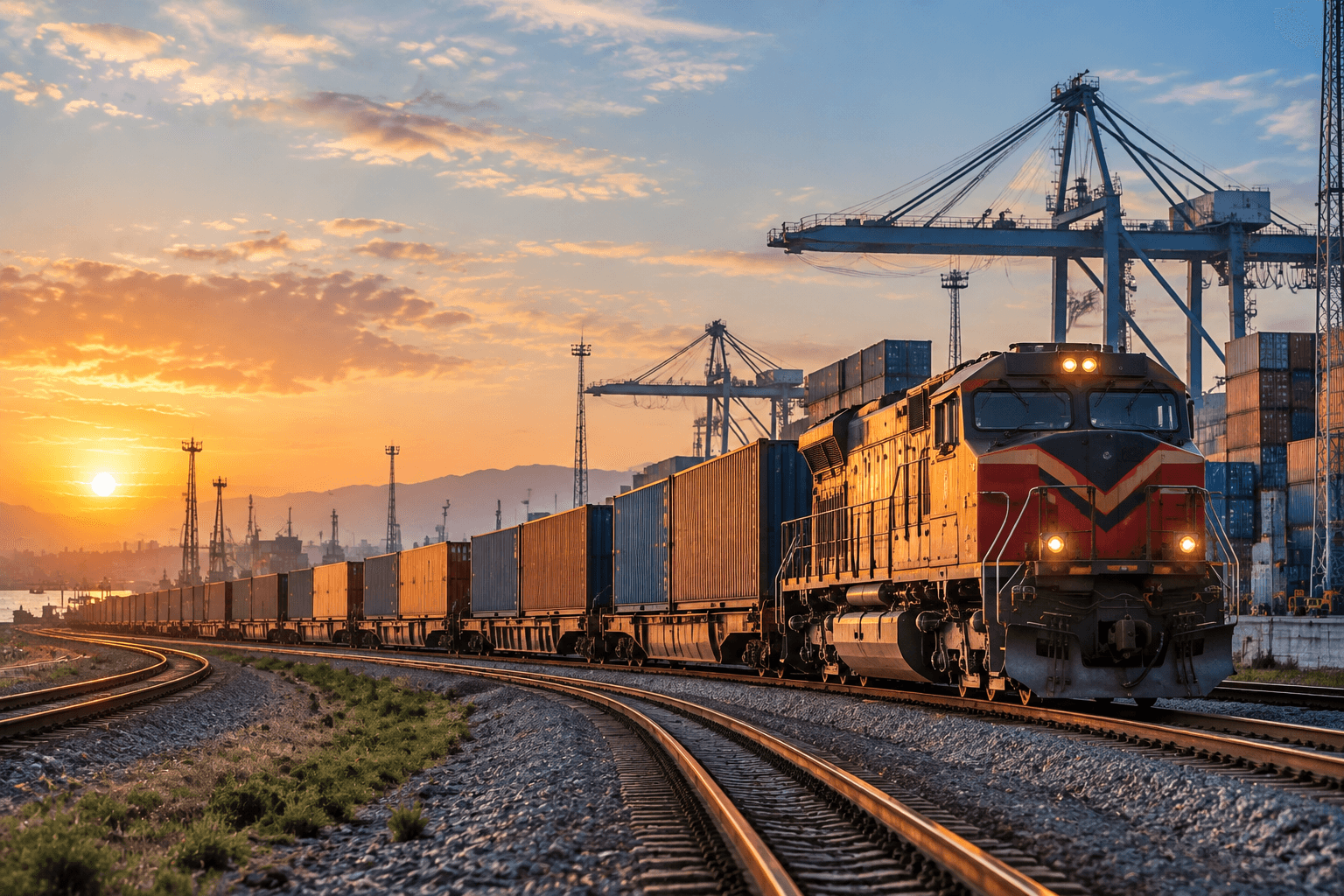
China-Europe Rail Corridor Hits Record Volume in Q2 2026
Rail freight between China and Europe continues to develop as businesses search for alternatives to traditional maritime routes. The corridor is becoming more than a backup option — it is becoming part of the permanent logistics strategy for many companies.
The railway is becoming a serious competitor to the ocean
For years, the standard answer to the question of moving goods between China and Europe was simple:
Ship by sea if you have time. Fly if you do not.
Rail occupied a much smaller space between the two.
That is changing.
As companies continue to search for faster and more resilient supply chains, the China-Europe rail network has become increasingly important.
The attraction is obvious.
Rail can offer:
Faster transit than traditional ocean freight
More predictable routing than some maritime alternatives
Lower cost than air freight
Access to major inland logistics hubs
Recent data reported on the China-Europe Railway Express points to strong activity in 2026, with first-quarter train volumes and containerized cargo increasing year-on-year.
Why companies are looking beyond the traditional sea route
The global logistics system has become increasingly sensitive to disruption.
A problem at a major maritime chokepoint can affect:
- Freight rates
- Insurance costs
- Transit times
- Inventory planning
- Production schedules
This has forced companies to rethink a long-standing assumption:
The cheapest route is not always the cheapest supply chain.
A route that costs less per container but takes several additional weeks may create greater costs elsewhere.
For example, a manufacturer may need to:
- Hold more inventory
- Delay production
- Pay for additional warehousing
- Use air freight for urgent components
Rail can therefore make sense even when its price is higher than standard ocean freight.
The role of inland logistics hubs
Rail is not simply about putting a container on a train.
The real strength of the China-Europe rail network comes from the infrastructure around it.
The route connects:
- Manufacturing centers
- Inland rail terminals
- Border crossings
- Warehouses
- Ports
- Distribution centers
This creates a network rather than a single route.
A shipment can move from a factory in China to an inland terminal, cross multiple countries by rail, and then continue by road or rail into its final European market.
That flexibility is becoming increasingly valuable.
Rail is not replacing ocean freight
This is an important distinction.
Rail is unlikely to replace maritime shipping for the majority of global cargo.
Ocean freight remains essential for:
- Large volumes
- Low-value goods
- Bulk shipments
- Long-term supply contracts
Instead, rail is becoming another tool in the logistics toolbox.
Companies are increasingly asking:
- Which goods need speed?
- Which shipments are time-sensitive?
- Which products justify higher transport costs?
- Which routes offer the best balance between price and reliability?
The answer may be different for every shipment.
The future is multimodal
The most resilient supply chains are rarely dependent on a single mode of transport.
A modern shipment may combine:
Factory → Truck → Rail → Truck → Distribution Center
Or:
Port → Rail → Warehouse → Last-Mile Delivery
This is the future of logistics.
Not choosing between sea, rail, road, or air.
But combining them intelligently.
Final thought
The China-Europe rail corridor is no longer simply an alternative for companies that cannot use the sea.
It is becoming a strategic option for companies that value:
speed, flexibility, and route diversification.
The companies that understand how to combine different transport modes will be better positioned for the next decade of global trade.